Build Profitable Padel Clubs Worldwide.

How to Start a Padel Club: Costs, ROI & Business Plan
The Traditional Process of Starting a Padel Club
Most guides on how to start a padel club follow a similar framework:
Step 1: Find a Suitable Location
Choose a site with good accessibility, parking and sufficient space for future expansion.
Step 2: Build the Right Number of Courts
Select court types, lighting systems and supporting facilities based on your budget and target market.
Step 3: Launch the Club
Complete construction, establish pricing and prepare daily operations.
Step 4: Attract Players and Build Membership
Promote the club, organize events and develop a loyal player community.
Why I Think Most Padel Club Guides Miss the Real Challenge
The traditional process focuses on building a club.
The real challenge is making the club profitable.
Many investors spend months comparing court specifications.
Very few spend the same amount of time validating demand, calculating occupancy targets or understanding local market conditions.
In my experience, a club’s success depends far more on occupancy and community than on the specific court model installed.

The First Thing I Would Analyze Is Not Court Cost
Most first-time investors spend weeks comparing court suppliers.
I understand why.
Courts are visible.
Court pricing is easy to compare.
But after reviewing dozens of projects, I believe investors often focus on the wrong number.
The most important number is usually not court cost.
It is occupancy.
A club with average courts and strong occupancy will outperform a club with premium courts and empty booking schedules.
Before I worry about steel structures, artificial turf or lighting systems, I would ask:
Who will play?
How often will they play?
Why will they choose my club instead of another sports facility?
Those answers determine profitability far more than the exact court specification.
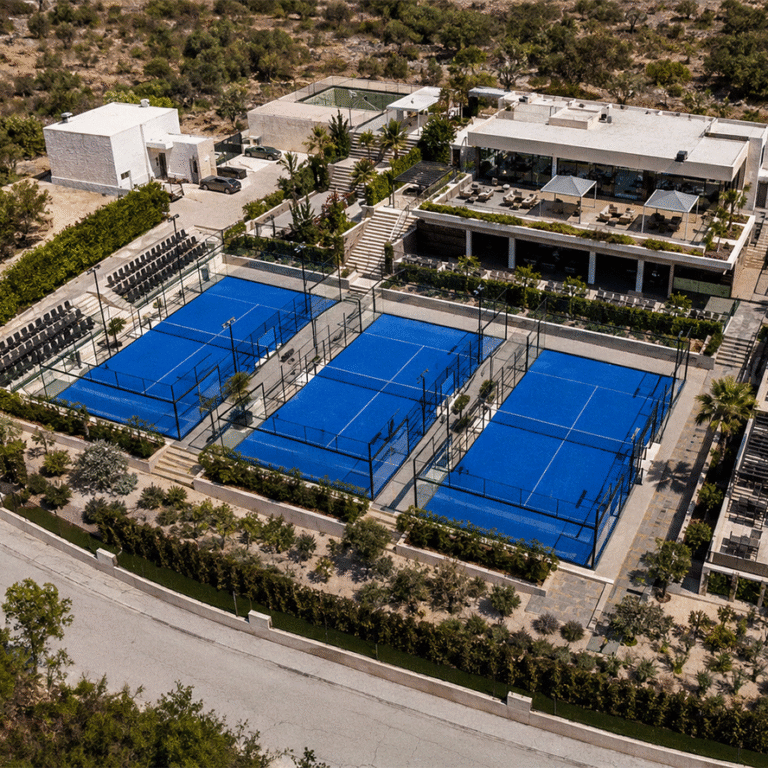
Why I Would Start With Four Courts Instead of Eight
One assumption many new investors make is that more courts automatically mean more profit.
In reality, larger projects create larger risks.
Imagine two clubs.
Club A has four courts operating at 60% occupancy.
Club B has eight courts operating at 30% occupancy.
The larger club may look more impressive, but the smaller club could generate stronger returns.
For most first-time operators, I believe four courts offer the best balance between investment cost, operational complexity and revenue potential.
Four courts are typically enough to:
Host social events
Run coaching programs
Organize small tournaments
Build an active community
Without creating excessive overhead.
Once demand is proven, expansion becomes much easier.

What I Learned From Watching Padel Grow in Shenzhen
A few years ago, very few people in Shenzhen had heard of padel.
Today, the situation looks completely different.
When I began researching the local market, I expected to find mostly professional players or international expats.
Instead, what stood out was how quickly ordinary sports enthusiasts became regular players.
Many players were:
Entrepreneurs
Office professionals
Fitness enthusiasts
International residents
People looking for a social sport after work
What surprised me most was the retention rate.
Unlike some sports that require years of training before becoming enjoyable, padel creates a rewarding experience almost immediately.
A beginner can have fun on the first day.
That is an incredibly powerful business advantage.
The easier it is for new players to enjoy the sport, the easier it becomes to grow a community.
And community is ultimately what drives occupancy.
The Business Model Most Investors Overlook
Many people assume court bookings generate all the revenue.
That is rarely true in successful clubs.
The strongest operators build multiple revenue streams.
Typical examples include:
Court Rentals
The foundation of the business.
Membership Programs
Predictable recurring revenue.
Coaching & Academies
Often one of the highest-margin services.
Corporate Events
An increasingly important source of weekday demand.
Tournaments & Leagues
Excellent for community building and customer retention.
Equipment Sales & Rentals
Additional revenue with relatively low operational complexity.
The clubs that rely on a single revenue source often struggle.
The clubs that build an ecosystem tend to perform much better.
What I Believe Matters More Than Market Size
Many investors ask:
“Which country has the biggest padel market?”
I think that is the wrong question.
The better question is:
“Where is demand growing faster than supply?”
Spain has one of the largest padel markets in the world.
But it is also highly competitive.
Emerging markets such as the United States, Saudi Arabia, UAE and parts of Asia may offer different opportunities because supply is still catching up with demand.
In many cases, being early in the right market is more valuable than entering the largest market.
A Simple ROI Reality Check
One reason I built ROI models for padel projects is because many investors have unrealistic expectations.
I often see assumptions such as:
80% occupancy
One-year payback
Extremely high court pricing
Those numbers look attractive in a spreadsheet.
They are much harder to achieve in real life.
A healthier way to evaluate a project is to ask:
“If occupancy reaches 40% within two years, does the investment still make sense?”
If the answer is yes, the project deserves serious consideration.
If profitability depends on perfect conditions, the risk is much higher.
In my experience, realistic assumptions usually produce better decisions than optimistic projections.
The Biggest Mistake New Padel Investors Make
If I had to choose one mistake, it would be this:
Investing in infrastructure before validating demand.
The most successful projects are not always the ones with the newest courts or the largest budgets.
They are the projects that understand their market.
They know who their players are.
They know how to keep courts occupied.
And they know how to build a community around the sport.
Courts can be purchased.
Communities must be built.
Final Thoughts
If I were starting a padel club today, I would spend less time comparing court specifications and more time understanding demand.
I would focus on occupancy before expansion.
I would start with a sustainable business model.
And I would treat padel not as a construction project, but as a long-term community business.
The global growth of padel creates exciting opportunities, but successful clubs are built on more than enthusiasm alone.
They are built on realistic planning, strong operations and a deep understanding of what players actually want.
Before making any investment decision, I would always test the numbers, evaluate the market and build a strategy that works even under conservative assumptions.