Build Profitable Padel Clubs Worldwide.

Padel Court Space Planning Calculator
Early-Stage Padel Project Planning
Padel Court Space Planning Calculator
Estimate how many padel courts can fit in your available space based on site size, layout type, facility areas and planning requirements.
Basic Project Information
Default scenario: 60m x 35m, Commercial Club, Standard Commercial Layout, Standard Buffer, Reception + Locker Rooms + Storage. Estimated capacity: 4 courts.
Advanced Planning Options
Site & Layout Assumptions
Facility Options
Visual Site Planning Preview
60m x 35m Site
Support FacilitiesReception Area, Locker Rooms, Storage Room
Conceptual Layout2 x 2 Commercial Club Layout
Early-stage layout illustration based on the estimated court capacity.
Planning FocusCommercial Club Planning
Use this preview to discuss access, circulation, support facilities and future expansion.
Design ReminderPlanning Preview Only
This is not a final architectural drawing. Final layout should review access routes, safety zones, drainage, columns, local regulations and installation details.
Turn Your Padel Project Into a Profitable Investment
What You'll Receive
1
STEP
Construction Cost AssessmentUnderstand realistic construction, site work and installation costs.
2
STEP
Recommended Club ConfigurationIdentify the optimal number of courts and facility setup for your project.
3
STEP
Revenue & ROI EvaluationEstimate occupancy, revenue potential and expected payback period.
4
STEP
Personalized Investment RoadmapReceive practical recommendations based on your location, budget and business goals.
Request Your Free Project AssessmentGet Expert Advice on Construction Cost, Court Configuration, Revenue Potential and ROI Planning.
Padel Court Space Planning Guide
How Much Space Do You Need for a Padel Club?
One of the first questions investors ask when evaluating a padel project is: How much space do I actually need?
The answer depends on far more than the dimensions of a single padel court. While a standard padel court measures 20m × 10m, successful commercial projects require additional space for player circulation, safety zones, reception areas, social spaces, parking and future expansion.
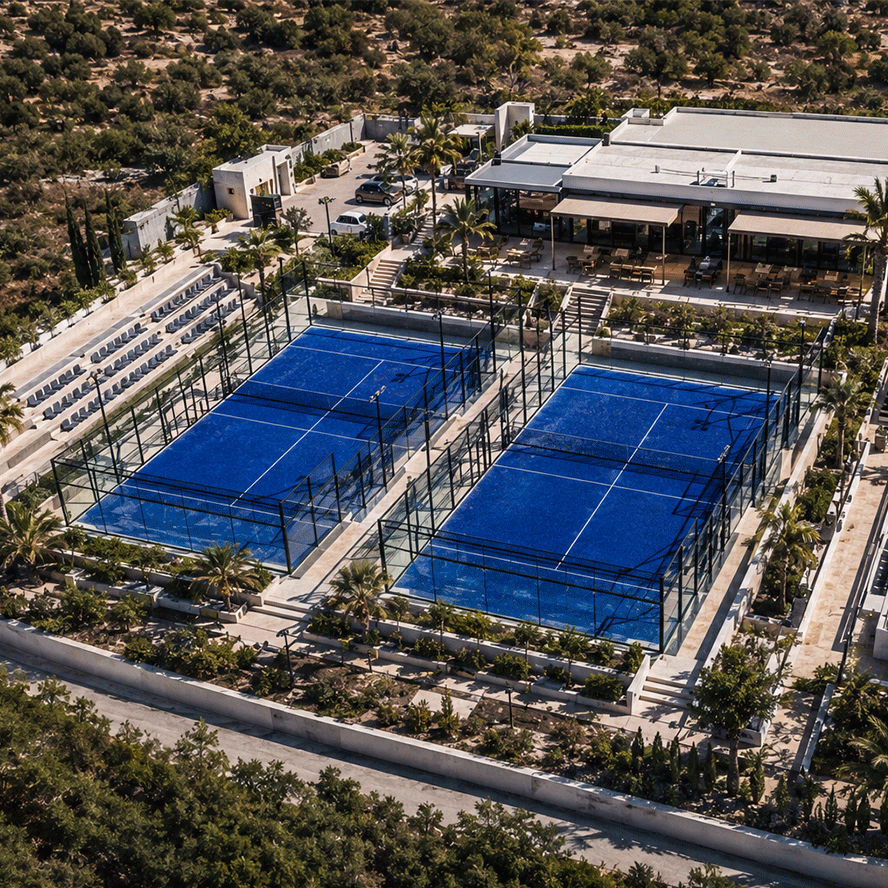
This is why professional padel club planning focuses on total site utilization rather than court dimensions alone.
A well-planned club is not simply a collection of courts. It is a business designed to generate recurring revenue, attract players and support long-term growth.
Typical Space Requirements by Project Size
The amount of land required depends on the number of courts, project objectives and supporting facilities.
| Project Type | Recommended Area |
|---|---|
| 1 Court | 250–400 sqm |
| 2 Courts | 600–900 sqm |
| 4 Courts | 1,500–2,500 sqm |
| 6 Courts | 2,500–4,000 sqm |
| 8+ Courts | 4,000 sqm+ |
These figures include circulation areas and basic operational space. Additional facilities such as clubhouses, cafés, locker rooms and spectator seating may require additional land.
Why Court Capacity Matters
Many first-time investors focus primarily on minimizing construction costs. However, court capacity often has a greater impact on long-term profitability than the initial investment itself.
For example, a two-court facility may require less capital, but it can also limit:
Membership growth
Limited capacity can reduce recurring membership potential.
Coaching programs
Fewer courts restrict private coaching and group training schedules.
Tournament hosting
Small facilities have less flexibility for events and leagues.
Peak-hour utilization
Limited court count can reduce availability during high-demand periods.
Revenue diversification
More courts support more booking, coaching and event revenue opportunities.
Future expansion opportunities
Planning capacity early helps avoid expensive redesign later.
In many markets, four courts are considered the minimum viable commercial model for building a scalable and profitable commercial padel club.
The goal is not simply to build courts. The goal is to build a business.
Beyond Court Dimensions
A successful padel project is not simply about fitting as many courts as possible into the available space.
Several important factors should be considered during the planning stage.
Site Shape
Two sites with the same total area may accommodate very different court layouts depending on their proportions and access points.
Player Circulation
Adequate walkways improve player experience, safety and operational efficiency.
Supporting Facilities
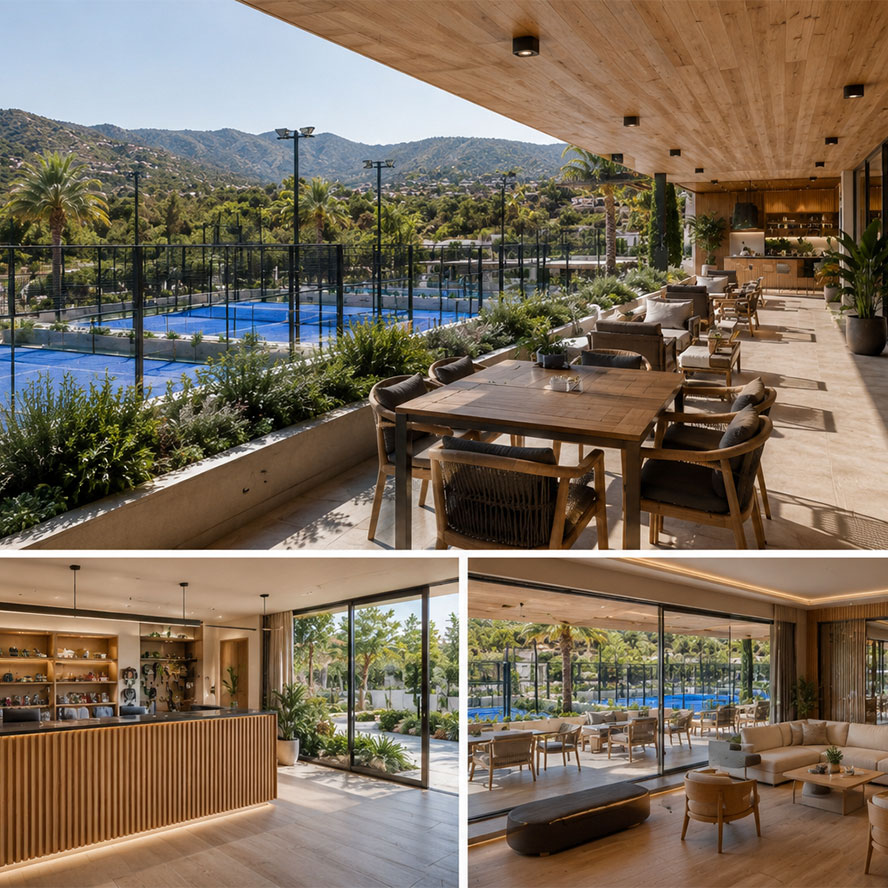
Commercial clubs often require reception areas, equipment storage, locker rooms, spectator seating and food and beverage spaces.
Future Expansion
Many successful clubs begin with four courts and expand as demand grows.
Leaving room for future development can significantly improve long-term returns.

What Does a Successful Padel Club Really Need?
Many investors assume that building courts is the most important part of the project.
In reality, successful clubs are built around player experience, operational efficiency and revenue generation.
The most profitable clubs typically combine courts with supporting facilities that encourage players to stay longer, visit more frequently and spend more per visit.
Depending on the project type, a successful club may include:
Reception & Check-In Area
Supports bookings, memberships and customer service.
Pro Shop & Equipment Sales
Creates additional revenue while improving player convenience.
Café or Social Lounge
Encourages longer visits and strengthens community engagement, especially for hotel and resort padel projects.
Locker Rooms
Important for membership-based clubs, coaching programs and tournaments.
Spectator Areas
Useful for leagues, tournaments and social events.
Coaching & Training Space
Supports training operations and long-term player development.
Parking Facilities
Convenient access can improve retention and utilization.
Future Expansion Areas
Supports long-term growth as demand increases.
While these facilities increase the initial space requirement, they often contribute significantly to long-term revenue and member retention.
Additional Space Requirements Often Overlooked
Many first-time investors focus only on court dimensions. However, successful clubs require more than courts alone.
Ignoring supporting facilities can limit player experience, reduce revenue opportunities and restrict future growth.
Reception Area
A dedicated reception area helps manage bookings, memberships and customer service. Most commercial clubs allocate 20–60 sqm depending on club size.
Pro Shop
Selling rackets, balls, grips, apparel and accessories can create an additional revenue stream while improving convenience for players.
Café & Social Space
One of the reasons padel has grown so rapidly is its social nature. A café or lounge area encourages players to stay longer, increases spending and strengthens community engagement.
Locker Rooms & Changing Facilities
For clubs targeting memberships, coaching programs or tournaments, locker rooms are often considered essential.
Spectator Areas
Viewing areas become increasingly important as clubs host leagues, tournaments and social events.
Parking
Parking availability is frequently underestimated during planning. In many markets, convenient access and parking can significantly influence player retention and facility utilization.
Future Expansion Space
Many successful clubs begin with two or four courts and expand as demand grows. Reserving space for future development can improve long-term returns and reduce future construction disruption.
Recommended Space Allocation for Commercial Clubs
The table below shows a typical commercial club planning model.
| Area Type | Recommended Share |
|---|---|
| Courts & Circulation | 65–75% |
| Reception & Administration | 3–5% |
| Locker Rooms | 5–8% |
| Café & Social Space | 5–10% |
| Storage & Maintenance | 2–4% |
| Spectator Areas | 3–5% |
| Future Expansion Buffer | 5–10% |
The optimal allocation depends on your target market, business model and growth strategy.
Projects designed around both operational efficiency and player experience often achieve stronger occupancy rates and higher revenue potential.
Choosing the Right Project Type
The ideal layout depends on your investment goals.
1–2 Courts
Suitable for: Hotels and Resorts, Residential Communities, Pilot Projects, Private Facilities.
4 Courts
Suitable for: Commercial Padel Clubs, Membership-Based Operations, Coaching Businesses, Local Tournaments.
6–8 Courts
Suitable for: Regional Sports Centers, Destination Clubs, High-Demand Markets, Multi-Revenue Operations.
8+ Courts
Suitable for: Large Commercial Clubs, Tournament Venues, Franchise Concepts, National Training Centers.
Choosing the Right Location for a Padel Club
Location is often a bigger factor in club success than court specifications.
A premium court in the wrong location may struggle to attract players, while a well-positioned facility can achieve strong occupancy rates even with a modest initial investment.
When evaluating a site, consider:
Local population density
Strong local demand supports recurring usage and memberships.
Existing sports participation
Nearby active sports communities can accelerate adoption.
Nearby competition
Competition affects pricing, differentiation and launch strategy.
Accessibility
Convenient access improves utilization and player retention.
Parking availability
Parking can directly influence repeat visits.
Visibility from major roads
Visible locations help reduce marketing friction.
Nearby residential communities
Residential demand can support consistent daily traffic.
Corporate demand
Corporate events and team activities can add revenue.
School and university demand
Education-based demand can support coaching and development programs.
Many failed sports facilities suffer from poor site selection rather than inadequate court quality.
For this reason, location analysis should be completed before finalizing court configuration and investment budgets.
Common Site Selection Mistakes
Choosing Low-Visibility Locations
Even high-quality facilities can struggle if potential players do not know they exist.
Underestimating Parking Requirements
Limited parking can reduce convenience and discourage repeat visits.
Ignoring Population Density
Strong local demand is often more important than premium padel court specifications.
No Room for Expansion
Many successful clubs expand within the first few years. Sites with no future growth capacity can limit long-term profitability.
Focusing Only on Construction Cost
The cheapest site is not always the most profitable site. Investors should evaluate both development cost and long-term revenue potential before making a final decision.
Space Planning Is Only the First Step
Understanding how many padel courts can fit on your site is an important starting point, but it is only one part of the investment decision.
Before moving forward with a project, investors should also evaluate:
Construction Costs
Estimate total project budget before committing to a site plan.
Revenue Potential
Understand booking, coaching and membership revenue scenarios.
Occupancy Assumptions
Test whether the expected utilization supports the project size.
Operating Expenses
Review staffing, maintenance, marketing and facility costs.
Expected Payback Period
Connect site capacity to return on investment.
Long-Term Growth Opportunities
Plan expansion from the beginning, not after demand arrives.
The most profitable projects are those that balance court capacity, player demand, operational efficiency and future scalability from the very beginning.
Frequently Asked Questions
01
How much space do I need for one padel court?
A single padel court typically requires 250–400 sqm when circulation areas, safety zones and access space are included.
02
How much land is needed for a commercial padel club?
Most commercial padel clubs require between 1,500 sqm and 4,000 sqm depending on the number of courts and supporting facilities.
03
How many padel courts fit in 1,000 sqm?
Depending on layout efficiency and supporting facilities, approximately 2–3 courts may fit within a 1,000 sqm site.
04
How many padel courts fit in 2,000 sqm?
Many four-court commercial clubs are developed on sites ranging from 1,500 sqm to 2,500 sqm.
05
What is the minimum size for a padel club?
A two-court facility is often considered the minimum size for a commercial project, although four courts are generally recommended for long-term growth.
06
Should I build two or four courts?
Four courts typically provide greater scheduling flexibility, stronger membership potential and more revenue opportunities than a two-court facility.
07
What is the ideal layout for a commercial padel club?
The ideal layout depends on your available space, target market and business model. Most successful commercial clubs are designed around four or more courts with room for supporting facilities.
08
Does court orientation matter?
Yes. Proper court orientation can improve player comfort and playing conditions, particularly for outdoor projects.
09
Can a tennis court be converted into padel courts?
Yes. Existing tennis facilities are commonly converted into one or more padel courts, often reducing development costs.
10
How much space should I reserve for future expansion?
Where possible, investors should reserve enough space for at least one additional court and supporting facilities.
11
Should I include a reception area?
Most commercial clubs benefit from a dedicated reception area for memberships, bookings and customer service.
12
Do I need locker rooms and changing facilities?
Locker rooms improve the player experience and are often expected in membership-based clubs and sports centers.
13
How much parking does a padel club need?
Parking requirements vary by market, but convenient parking can significantly improve player retention and facility utilization.
14
What is the best location for a padel club?
Locations with strong population density, good accessibility, nearby residential communities and growing sports participation often perform best.
15
What should I do after estimating court capacity?
The next step is evaluating construction costs, revenue potential, operating expenses and expected ROI before making an investment decision.
From Available Space to a Profitable Padel Club
Understanding how many courts fit on your site is only the beginning.
Before investing in a padel project, it is important to evaluate construction costs, revenue potential, occupancy assumptions and long-term profitability.
Use our free planning tools to estimate project feasibility and build a realistic investment strategy.
Padel Court Space Planning Calculator
Plan court capacity, optimize site utilization and explore practical layout options.
Plan Site CapacityPadel Court Construction Cost Calculator
Estimate construction budgets and compare project investment requirements.
Estimate Build CostPadel Club ROI Calculator
Analyze revenue projections, operating costs and expected payback periods.
Calculate Club ROIPadel Club Business Plan
Explore business strategies, financial models and growth opportunities.
Build Business PlanTurn Your Padel Project Into a Profitable Investment
What You'll Receive
1
STEP
Construction Cost AssessmentUnderstand realistic construction, site work and installation costs.
2
STEP
Recommended Club ConfigurationIdentify the optimal number of courts and facility setup for your project.
3
STEP
Revenue & ROI EvaluationEstimate occupancy, revenue potential and expected payback period.
4
STEP


